You’ve got questions? We’ve got answers!
To assist employers in determining whether a Flexible Spending Arrangement (FSA) plan is a good fit for their organization, we’ve created this helpful resource of Frequently Asked Questions (FAQs). Learn more about VitaFlex here, or request a custom proposal.
For FAQs specific to VitaFlex participants, click here.
A Flexible Spending Arrangement Plan, also known as an FSA Plan or Cafeteria Plan, is an employee tax-savings program governed by IRS Code Section 125. Participants make an annual election to reduce their taxable income by the amount they anticipate spending on qualified medical and dependent care expenses during the Plan Year. Once medical and dependent care expenses have been incurred, participants may submit claims for tax-free reimbursement from their employer.
Employees can make elections for two separate FSA accounts:
- Medical FSA: This plan allows employees to pay for medical, dental, and vision expenses for themselves, their spouse, and/or tax dependents.
- Dependent Care FSA: This plan allows employees to pay for childcare expenses for any children under the age of 13, which allow the employee and their spouse to work.
The accounts are separate and money elected for one account cannot be used to pay for expenses attributable to the other account.
Return to Top
With medical costs continuing to rise, employers are looking for ways to control their group health care expenses. Implementing an FSA plan can provide a strategic way to control overall benefit costs without reducing benefits. Through an FSA plan, employers and their employees have the opportunity to save a significant amount in taxes. Learn more about why you should offer an FSA Plan.
Return to Top
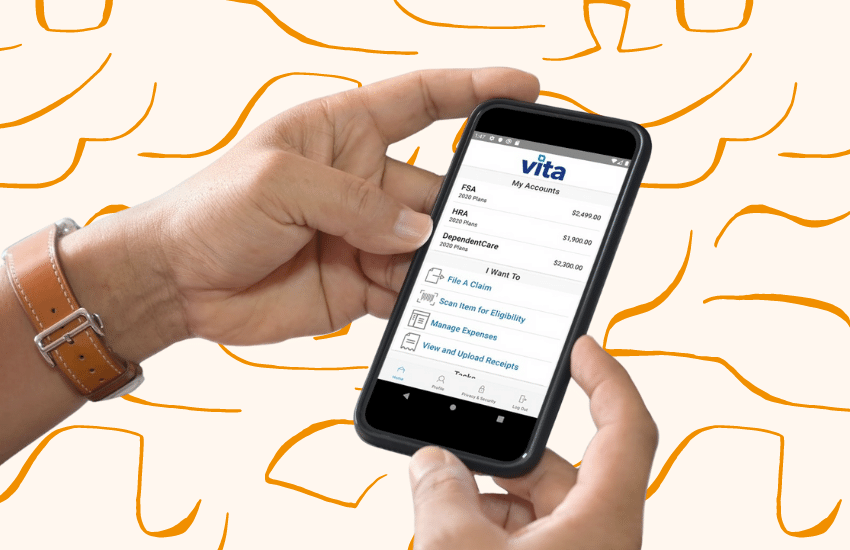
Vita has developed VitaFlex, a comprehensive Section 125 FSA administration system for medical reimbursement and dependent care reimbursement plans. VitaFlex provides superior administrative service that fully complies with IRS regulations and federal law protecting personal health information. Following are some of the features of VitaFlex:
- Plan design customization (debit card, grace period, reimbursement methods)
- Signature-ready plan documentation
- Discrimination testing and IRS Form 5500 preparation
- Personalized education and enrollment materials
- IRS audit-proof claims adjudication
- Next business day claims processing turn-around
- Employer online access to reports
- Participating employee online account access, including personal claims history
- Knowledgeable on-site Customer Service Center
If you are interested in learning more, you can request a custom VitaFlex proposal here.
Return to Top
Currently, employers can decide the maximum amount that employees can elect for their medical FSA. The important thing to note is that the higher the employee election maximum, the greater the risk of loss for the employer.
Dependent care FSAs currently have a government mandated $5,000 maximum amount that employees can elect. If the employee is married and filing taxes jointly, the household maximum election amount is $5,000. If the employee is married and filing taxes separately, each spouse can elect a maximum of $2,500.
Return to Top
Employee salary reductions are typically divided out and taken via payroll on a uniform basis throughout the course of the Plan Year. It is important to note that an employer can only take FSA reductions for the current Plan Year. If reductions are missed for any reason, the employer must take catch-up reductions prior to the end of the Plan Year.
Return to Top
FSA participants access their funds by submitting a claim for their eligible medical, dental, vision, or childcare expenses. If the documentation submitted to substantiate the claim is deemed sufficient, a tax-free reimbursement is issued by the employer. With VitaFlex, employers have the ability to reimburse their employees in several ways, including payroll reimbursements, separate checks, and separate direct deposits.
Many FSA plans also offer their participants an FSA debit card. While this option allows employees the convenience of paying for expenses directly out of their FSA balance, many debit card charges must still be substantiated with documentation on an after-the-fact basis.
Return to Top
Yes. While employees carry the risk of forfeiting any funds they do not use by the end of a Plan Year to the employer – commonly called the “use it or lose it” rule – employers are subject to the “uniform coverage” rule. The uniform coverage rule mandates that an employee must have the ability to be reimbursed for their entire medical FSA election amount regardless of how much the employee has contributed to their FSA to date. This means that if an employee is reimbursed for their full medical election amount early in the Plan Year, there is a possibility that the employer may not be able to recoup the entire election amount through reductions if the employee leaves the company before the end of the Plan Year. More often than not, these types of employer losses are mitigated by employee forfeitures.
The uniform coverage rule does not apply to dependent care FSA plans, so the employer financial risk is negligible.
Return to Top
Yes. FSA plans have numerous non-discrimination testing requirements for both medical and dependent care FSAs. VitaFlex provides FSA non-discrimination testing at no additional charge to clients.
Return to Top
Absolutely! VitaFlex offers the ability to customize FSA plans to suit the unique needs of each company. Custom plan design options include implementation of the grace period, usage of debit cards for medical FSAs, and a variety of reimbursement methods including payroll and direct deposit.
Return to Top
VitaFlex clients have direct access to a dedicated account manager and support team, in addition to executive-level support within the Vita organization. VitaFlex clients also have access to a full suite of online resources, including archived reports, forms, an eligible expense database, and much more.
Return to Top